

Beyond Testosterone: How Peptide Therapy Is Changing What’s Possible for Men’s Health
You’ve been told your labs are normal, your testosterone came back “in range,” and your doctor said everything looks fine, but you still feel off. The fatigue is real, the belly fat that won’t move is real, and the mental fog, slower recovery, and sleep that never quite restores your symptoms with identifiable causes is real. Peptide therapy for men in Denver represents one of the more meaningful advances in men’s hormone optimization, and at Vibrant Health of Colorado, we evaluate the full picture before recommending anything.
What Is Peptide Therapy for Men?
In short, targeted peptide therapy uses short chains of amino acids to signal the body to produce hormones, repair tissue, and regulate metabolism. For men specifically, this typically means growth hormone secretagogues that stimulate the pituitary gland to release growth hormone naturally rather than replacing it with synthetic human growth hormone (HGH). These are prescription-grade protocols that are clinician-supervised and targeted to each patient’s labs and symptoms, making them meaningfully different from anything available over the counter.
Why Testosterone Alone Does Not Always Tell the Whole Story
Most men who come to us have already been down the testosterone road, with some on testosterone replacement therapy (TRT) who still feel suboptimal and others who’ve had their levels checked, been told everything is fine, and been sent home with no answers. Testosterone is one piece of a much larger hormonal picture, and for men in their 40s and 50s, something else is also declining at the same time: growth hormone.
HGH production begins to fall in a man’s 30s and continues dropping by roughly 14 to 15 percent per decade, so by the time a man reaches 50, his output may be significantly lower than it was in his prime. That decline doesn’t show up on a standard testosterone panel, but it does show up in stubborn visceral fat, poor sleep, slow recovery, and a mental fog that isn’t quite depression, but isn’t sharpness either. This is the gap that men’s hormone optimization should address, and it’s the gap a testosterone-only approach consistently misses since Insulin-like Growth Factor 1 (IGF-1), the primary marker of growth hormone activity, is rarely included in a standard primary care blood panel.
At Vibrant Health, when we run advanced lab work that includes IGF-1 alongside total and free testosterone, thyroid markers, cortisol, and metabolic indicators, we often find that a man’s testosterone is adequate while his growth hormone axis is clearly underperforming. And since fatigue, reduced lean muscle, increased body fat, poor sleep, and declining motivation can all reflect growth hormone decline just as much as low testostone, treating one without evaluating the other means the patient keeps feeling off even when the numbers look fine on paper.
Our root-cause philosophy means we don’t stop at one hormone. Instead, we assess the full system, identify what’s contributing to your symptoms, and build a complete protocol that addresses what’s off.
How Peptide Therapy Works: Signaling the Body to Do What It Already Knows How to Do
Growth hormone (GH) secretagogues don’t replace growth hormone, they signal the pituitary to produce and release it, keeping the body’s own feedback systems intact so output adjusts naturally, and this pulsatile release mirrors how the body secretes growth hormone in pulses throughout the night.
Synthetic HGH bypasses that system entirely, delivering exogenous hormone directly in a way that can cause the pituitary to reduce its own production over time, whereas secretagogues work upstream of that, prompting the body to do something it already knows how to do, just at a level it’s stopped doing efficiently on its own. For most men considering men’s growth hormone peptides, this physiologically aligned approach is the more appropriate starting point.
Sermorelin Therapy: The Foundational Growth Hormone Peptide
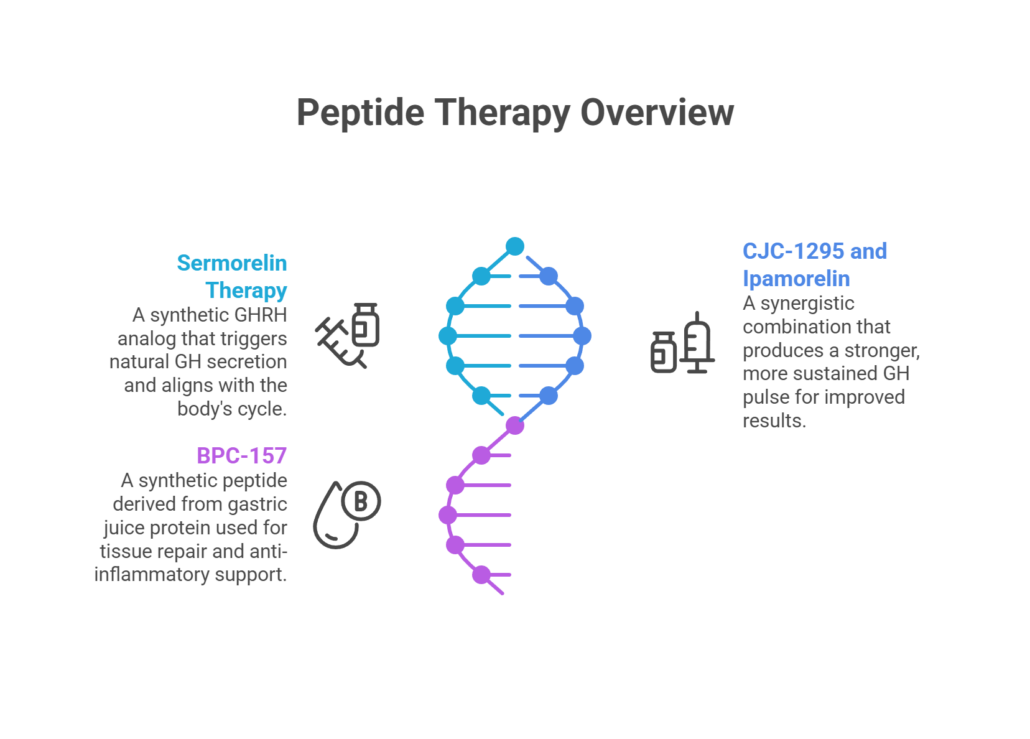
Sermorelin is a synthetic analog of growth hormone releasing hormone (GHRH), the same signal the hypothalamus sends to the pituitary to trigger GH secretion, and when administered by subcutaneous injection at night it aligns with the body’s natural GH cycle. It is one of the most studied peptides in this category, with patients often reporting improvements in sleep quality within the first few weeks, followed by reductions in visceral fat and modest gains in lean muscle over a longer timeframe. Because sermorelin stimulates the body’s own pituitary function rather than replacing a hormone externally, it is a strong foundational option for men in their late 30s or 40s who want a measured, lower-intensity protocol.
CJC-1295 and Ipamorelin: A Synergistic Combination for Sustained Results
CJC-1295 is a GHRH analog with a longer half-life than sermorelin, sustaining the stimulating signal to the pituitary over a longer window, while ipamorelin acts through a separate receptor pathway and mimics ghrelin signaling, and when combined they produce a stronger, more sustained GH pulse than either would alone. Benefits from this combination include improved lean mass, reduced visceral fat, better sleep architecture, and faster recovery, with dosing individualized based on a patient’s labs and response since we monitor IGF-1 levels and adjust over time rather than applying a static protocol.
BPC-157: The Recovery Peptide Men Are Asking About
BPC-157 is a synthetic peptide derived from a protein found in gastric juice, studied primarily for tissue repair and anti-inflammatory properties, making it the peptide men most often ask about for joint and tendon recovery, gut lining support, and post-exercise healing. Unlike growth hormone secretagogues, it doesn’t act on the GH axis and is used as a recovery peptide in combination protocols when a patient has a specific injury, chronic joint issue, or significant gut health component, and we evaluate its appropriateness individually rather than prescribing it as a default.
Peptide Therapy vs. Synthetic HGH: Why Most Men Do Not Need the Latter
Most men who are good candidates for growth hormone optimization don’t need synthetic HGH, and the clinical distinction between the two approaches is meaningful.
| Synthetic HGH | Growth Hormone Secretagogues (Peptides) |
| Delivers exogenous hormone directly | Stimulate the body’s own pituitary to produce GH |
| Bypasses the body’s natural feedback loop | Preserve the body’s natural feedback and regulation |
| Can suppress endogenous GH production over time | Support pituitary function rather than replacing it |
| FDA-approved only for documented GH deficiency diagnoses | Prescribed for age-related GH decline and related symptoms |
| Carries risks including fluid retention, joint pain, insulin resistance | Lower risk profile at therapeutic doses under clinical supervision |
| Significantly higher cost | More accessible, particularly within a membership model |
If your pituitary is still capable of producing GH but isn’t doing so efficiently because of age-related decline, a GH secretagogue is the physiologically appropriate choice since it works with your system rather than around it, and we evaluate IGF-1 levels, symptom presentation, and relevant health history to determine which approach fits each patient.
Who Is a Good Candidate for Men’s Growth Hormone Therapy in Denver?
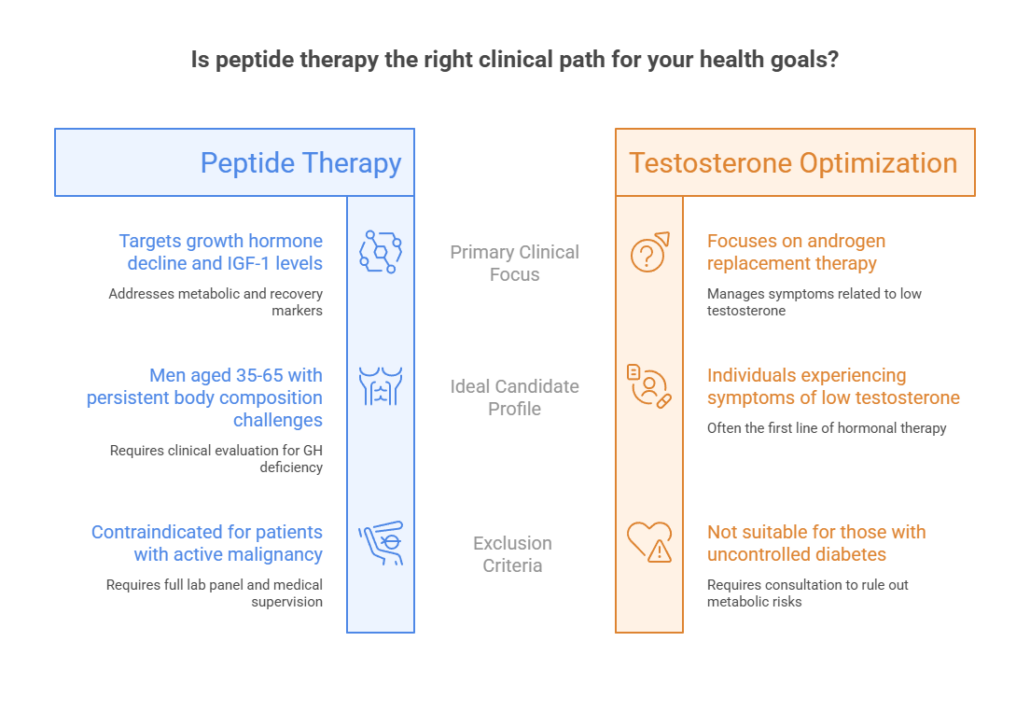
Men’s growth hormone optimization therapy in Denver isn’t for everyone, and part of what makes our approach different is that we say that clearly, since peptide therapy requires a thorough clinical evaluation rather than a self-assessment based on symptoms alone. Men who typically qualify are in the 35 to 65 age range with symptoms of GH decline despite adequate testosterone, including men on TRT who still experience suboptimal recovery, poor sleep, or persistent body composition challenges that testosterone optimization hasn’t resolved. The markers we look for include low or low-normal IGF-1 levels, elevated visceral fat, poor sleep that doesn’t respond to standard interventions, slow exercise recovery, and fatigue that hasn’t resolved with testosterone optimization alone.
There are also patients for whom peptide therapy is not appropriate, including those with active malignancy, certain metabolic conditions, and uncontrolled diabetes, which is why a full lab panel and clinical consultation are required before we recommend anything.
Peptide protocols require medical supervision and are only prescribed after appropriate lab evaluation. These are not supplements, and they’re not prescribed based on symptoms alone.
Ready to explore whether peptide therapy is right for you? Schedule a consultation with one of our clinicians to review your labs, symptoms, and options, or call us at (303) 730-2229.
What Peptide Therapy Looks Like at Vibrant Health of Colorado
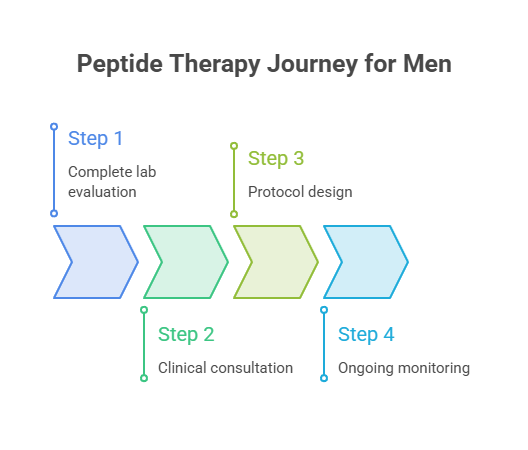
When men come to us asking about peptide therapy, we don’t start with a protocol, we start with a conversation and a full lab panel that gives us a real picture of what’s happening before any prescription is written.
- Step 1: Complete lab evaluation: We run a panel that includes IGF-1, total and free testosterone, thyroid markers, cortisol, metabolic markers, and a cardiovascular risk assessment, because we want to understand what’s happening in your body rather than simply addressing the symptoms you walked in with.
- Step 2: Clinical consultation: You sit down with one of our clinicians to review your labs, health history, symptoms, and goals in an extended visit rather than a 10-minute appointment, which is exactly what our functional medicine approach is built around.
- Step 3: Protocol design: If peptide therapy is appropriate, we design a protocol that may include a growth hormone secretagogue, a recovery peptide, and any adjustments to existing hormone protocols, with all peptides sourced from licensed compounding pharmacies.
- Step 4: Ongoing monitoring: We check IGF-1 and relevant markers at appropriate intervals and adjust dosing based on what the data shows, because peptide therapy is an ongoing clinical relationship, not a one-and-done prescription.
Our clinical team includes IFMCP-certified providers, Nutritional Therapy Practitioners, and Master Restorative Wellness Practitioners, and men are a fully welcome and growing part of this practice.
Integrated Care: Why a Functional Medicine Practice Is the Right Place for Peptide Therapy
There are roughly 40 peptide therapy providers in the Denver area, and most prescribe peptides in isolation without evaluating cardiovascular risk, thyroid function, gut health and the microbiome, or the patient’s broader metabolic picture, which consistently misses what makes peptide therapy most effective: integration with the rest of your health.
At Vibrant Health of Colorado, the most important clinical approach we offer is “normal” care. When you receive peptide therapy at Vibrant Health, it’s coordinated with your comprehensive primary care, cardiovascular prevention, hormone optimization, and overall metabolic health, so we’re managing a whole person rather than prescribing a single compound.
Our membership-based approach to functional medicine runs approximately $225 per month, compared to the $500 to $2,000 per month other clinics along the Front Range charge. When combined with comprehensive primary care, our transparent membership-based model is built for longitudinal care where ongoing monitoring, dosing adjustments, and coordination across health systems are part of the service rather than billed as extras.
For men’s functional medicine in Denver, the difference between a functional medicine practice and a single-service peptide clinic is the difference between treating a symptom and addressing the system causing it.
Frequently Asked Questions About Peptide Therapy for Men
How long does it take to see results from peptide therapy?
Most men notice improvements in sleep quality and recovery within four to six weeks, while body composition changes typically become measurable over a three to six month window depending on which peptide is used, your starting IGF-1 level, and your overall health picture.
Are peptides safe?
At therapeutic doses under clinical supervision, growth hormone secretagogues like sermorelin and CJC-1295/ipamorelin have a well-established safety profile, though individual factors always matter, which is why we require complete lab work before prescribing and monitor IGF-1 to avoid supraphysiological levels.
Do I need to be on TRT to benefit from peptide therapy?
Peptides and testosterone address different hormonal axes, so you can benefit from a growth hormone secretagogue whether or not your testosterone is optimized, and many patients see meaningful improvement from peptide therapy alone, though we evaluate the full hormonal picture for every patient.
Are peptides FDA-approved?
Some peptides, including sermorelin, have FDA approval for specific indications, while others such as BPC-157 and CJC-1295/ipamorelin are prescribed as compounded medications through licensed compounding pharmacies, meaning they are prescription-grade compounds regulated differently from over-the-counter products.
How are peptides administered?
Most growth hormone secretagogues are administered by subcutaneous injection at night to align with the body’s natural GH pulse, the injections are small and straightforward, and every patient is walked through the process before administering on their own, while some peptides have oral or intranasal forms depending on the protocol.
What does the evaluation process look like?
We start with a complete lab panel that includes IGF-1, testosterone, thyroid, cortisol, and metabolic and cardiovascular markers, then meet with you in an extended consultation to review the results and your health history, so that if peptide therapy is appropriate we can design a personalized protocol with a monitoring schedule that fits your clinical picture.
Can men in Colorado access peptide therapy via telehealth?
Statewide telehealth makes consultations accessible to men across Colorado, with Denver peptide therapy available in person at our Lone Tree and Eagle clinics and initial consultations and follow-up visits conducted via telehealth for patients elsewhere in the state.
Take the first step toward feeling better. Our integrated primary care and functional medicine approach will evaluate whether peptides fit your health picture. Schedule your consultation today at our Lone Tree clinic, Eagle clinic, or via statewide telehealth.
Practical Next Steps: How to Get Started with Peptide Therapy in Denver
If you recognize what we’ve described, including fatigue that lingers despite decent sleep, a midsection that changed despite gym consistency, recovery that takes longer than it used to, and mental sharpness that isn’t where it was a few years ago, these are symptoms worth investigating rather than dismissing.
Here’s where to start. First, take stock of your symptoms honestly, since fatigue, poor recovery, weight gain despite exercise, disrupted sleep, and reduced motivation are all worth noting before a consultation. Second, request a lab panel that includes IGF-1 and not just testosterone, since it is the most direct indicator of growth hormone activity and is left out of many standard primary care panels. Third, schedule a consultation with a clinician who evaluates the full hormonal picture rather than a single marker.
You can visit us in person at our Lone Tree clinic at 10099 RidgeGate Parkway, Suite 410, or at our Eagle clinic at 1143 Capitol St., Suite 101A for Vail Valley patients, and statewide telehealth is available for men across Colorado who can’t make it to either location. For more context on peptide protocols, our peptide therapy guide covers the foundational concepts in depth.
You deserve a provider who listens, runs the right labs, and explains what you’re working toward and why, and that’s what we do at Vibrant Health of Colorado, so call us at (303) 730-2229 or schedule your consultation today.

Deanna Woodroffe, WHNP, is the founder of Vibrant Health of Colorado and a passionate Women’s Health Nurse Practitioner with a focus on functional and integrative medicine. Early in her career, she became frustrated with the inability of traditional medicine to treat her patients’—and her own—chronic symptoms, driving her to pursue a fellowship in Anti-Aging and Functional Medicine. With over twenty years of experience, Deanna helps patients resolve complex, chronic symptoms by focusing on root causes and restoring balance to the body. Her comprehensive approach utilizes bio-identical hormone therapy, thyroid optimization, and addressing lifestyle factors like nutrition and stress to return her patients to feeling vibrant.



Leave a Reply
Want to join the discussion?Feel free to contribute!