

The Missing Piece in Your GLP-1 Journey: How Hormone Imbalances Quietly Sabotage Weight Loss Results
You’ve been on semaglutide for months, the scale barely moved or it moved for a while and then stopped, and you followed the protocol, reduced your calories, and still the results weren’t what you were promised, so if that’s where you’re right now, we want you to say something clearly: this isn’t your fault, and the medication itself may not be the problem. What we see regularly in our Denver functional medicine practice is that patients who aren’t responding the way they expected almost always have an underlying hormonal story that hasn’t been told yet, because thyroid dysfunction, perimenopause, low testosterone, chronically elevated cortisol, and insulin resistance can each create a biological ceiling on what any weight loss medication can achieve, and our functional medicine approach at Vibrant Health of Colorado is built around finding and addressing those ceilings rather than just writing a prescription.

The Short Answer: Why Your GLP-1 May Not Be Working
GLP-1 medications reduce appetite and improve insulin signaling, but they don’t correct thyroid dysfunction, declining sex hormones, elevated cortisol, or the metabolic slowdown of perimenopause, and when those hormone imbalances are present but unaddressed, they place a hard limit on what the medication can achieve. Hormone imbalance weight loss is a real, clinically recognized pattern, and it is the most common thing we find when a patient tells us their GLP-1 stopped working, so for a broader look at GLP-1 therapy in Colorado, our Functional Medicine Guide to GLP-1s covers the fundamentals in detail.
GLP-1 Medications and Hormone Imbalance Weight Loss: Why the Two Are Inseparable
Common GLP-1 receptor agonists like semaglutide, found in Ozempic and Wegovy, and tirzepatide, found in Mounjaro and Zepbound, work through several overlapping pathways, slowing how quickly food leaves your stomach, reducing hunger signals in the brain, and improving how cells respond to insulin, and for many patients, especially in the first few months, this produces meaningful results. The problem is that these mechanisms don’t operate in isolation. They work within a hormonal and metabolic environment, and if that environment is significantly disrupted, the medication’s reach is limited, so think of it like trying to fill a bathtub with the drain partially open, where the medication is running water in but if thyroid function is suppressed, cortisol is chronically elevated, or estrogen has dropped significantly, the drain is open in ways that blunt the result regardless of how well the medication is working. Thyroid hormones govern how fast your cells burn energy at rest, while sex hormones affect where your body stores fat and how much lean muscle you maintain, and cortisol, when chronically elevated, signals your body to hold onto visceral fat and causes cravings for high-calorie foods, while insulin resistance compounds all of these effects by keeping blood sugar dysregulated even as the GLP-1 medication tries to correct it. This is why our root-cause approach to functional medicine and weight loss in Denver starts with comprehensive testing before we ever discuss a prescription, because the prescription may absolutely be part of the plan, but it shouldn’t be the whole plan.
The Hormones That Undermine GLP-1 Results (And How to Find Them)
Most GLP-1 prescribers run a basic metabolic panel and check thyroid-stimulating hormone (TSH), but we don’t think that’s enough, and our patients’ lab results have confirmed that repeatedly, so what follows is the hormonal checklist most GLP-1 programs skip entirely and the one we consider standard before building any weight loss plan.
Thyroid Dysfunction: The Metabolic Dimmer Switch
Thyroid hormones control metabolic rate at the cellular level, and when thyroid function is low, your body burns fewer calories at rest, meaning GLP-1 medications can reduce how much you eat but cannot replace the metabolic fuel that properly functioning thyroid hormones provide. Standard TSH testing catches many cases of hypothyroidism, but it misses a significant number of patients with functional thyroid dysfunction where TSH is technically within range but free T3 is low, or reverse T3 is elevated and blocking the active hormone from doing its job, and for thyroid weight loss in Colorado patients this distinction matters enormously, which is why we run full thyroid panels including TSH, free T3, free T4, and reverse T3 because partial testing produces partial answers. Symptoms that suggest your thyroid may be working against your GLP-1 results include:
- Persistent fatigue even after sleeping adequately
- Cold hands and feet or always feeling colder than others
- Hair thinning or noticeable shedding
- Brain fog and difficulty concentrating
- Weight that isn’t moving despite eating less
Low Testosterone: The Muscle and Metabolism Problem in Both Women and Men
Muscle tissue burns more calories at rest than fat tissue, and that’s straightforward physiology rather than a wellness talking point, which is one reason why muscle loss during GLP-1 therapy can slow or stall weight loss over time, because testosterone is one of the primary hormones responsible for maintaining lean muscle mass and low levels accelerate muscle loss in both women and men. In women, testosterone is often overlooked entirely, but it plays a meaningful role in energy, body composition, and metabolic function, and when testosterone is low, women often notice fatigue that doesn’t resolve with sleep, reduced motivation to exercise, and difficulty maintaining muscle even with resistance training, while in men declining testosterone compounds weight gain, increases abdominal fat, and blunts the GLP-1 response through reduced metabolic activity. We test free testosterone and sex hormone-binding globulin (SHBG) as part of our standard hormone panel because total testosterone alone can look normal while free testosterone is significantly low.
Cortisol and Chronic Stress: How Your Stress Hormones Block Fat Loss
Elevated cortisol is not just a feeling of being stressed, because it is a physiological signal that tells your body to store fat particularly in the abdomen and to hold onto it as a survival resource, while chronically elevated cortisol also impairs insulin sensitivity, disrupts thyroid function, causes cravings for calorie-dense foods, and fragments sleep, which then keeps cortisol elevated the next day. GLP-1 medications suppress appetite signals effectively, but they cannot override a cortisol-caused fat-storage state, which is why patients who are under significant work pressure, caring for aging parents, or dealing with poor sleep often see minimal GLP-1 response compared to patients with lower stress loads, and Denver hormone optimization has to account for this since our approach to cortisol imbalance evaluates adrenal function alongside sex hormones and thyroid, because treating one without the others produces incomplete results.
Insulin Resistance: The Root That GLP-1 Addresses Partially
One reason GLP-1 medications work well for many patients is that they improve insulin signaling, which directly addresses one driver of fat storage and metabolic dysfunction, but when insulin resistance is severe, or when it’s caused by high cortisol, low thyroid function, or declining estrogen, the GLP-1 benefit is meaningfully blunted and the medication is improving one part of a larger problem. Standard fasting glucose or A1c alone won’t tell us the full story, and fasting insulin levels, advanced lipid markers, and inflammatory markers give a much clearer picture of how deeply insulin resistance is affecting your metabolism, which is why our metabolic and cardiovascular testing is built to capture that fuller picture and we use those markers to calibrate the full treatment plan rather than adjusting GLP-1 dose in isolation. 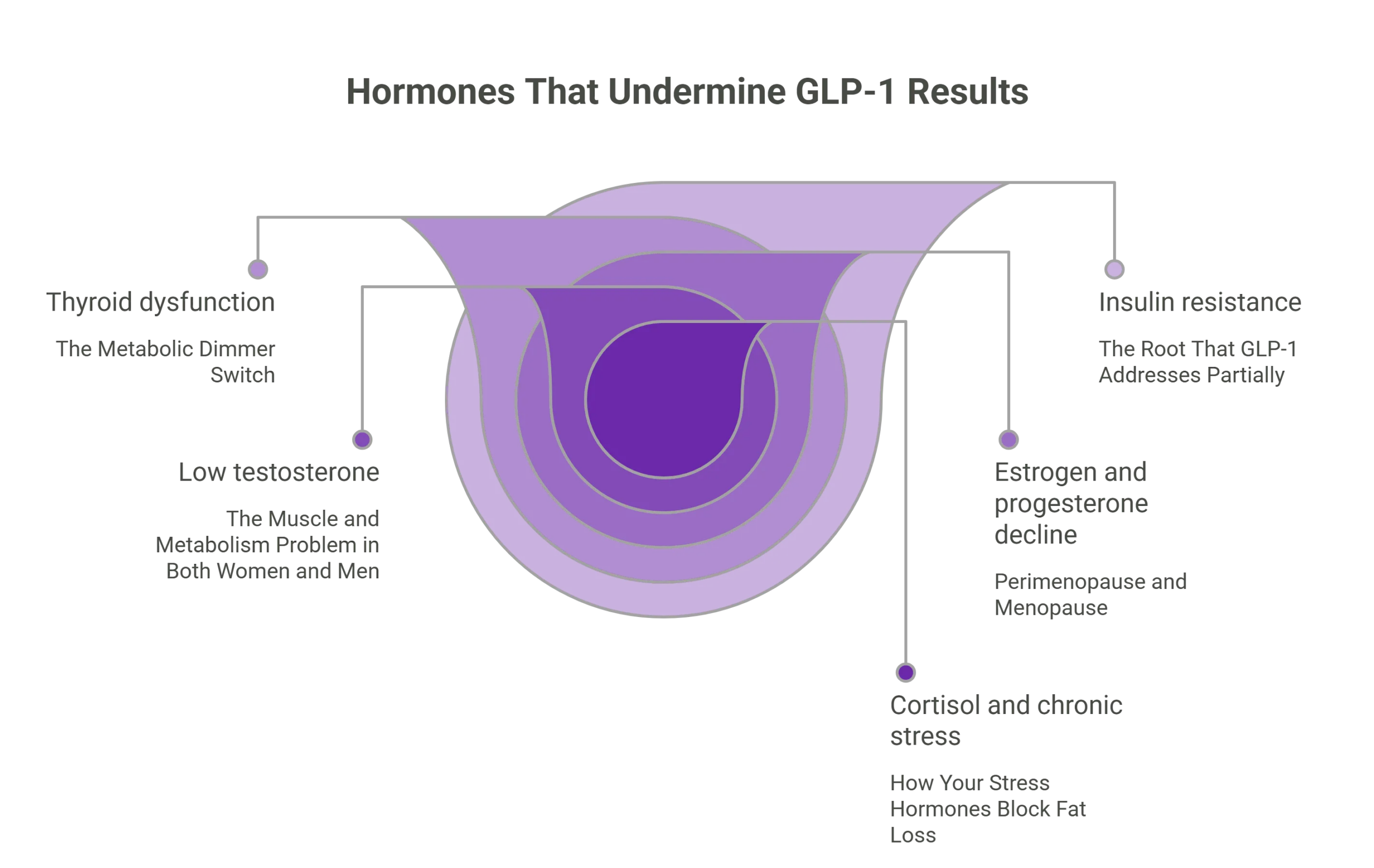
What Comprehensive GLP-1 Care Actually Looks Like
Most GLP-1 programs in Denver operate on a straightforward model: a brief intake visit, a prescription, and automated refill reminders, and that works for some patients but for patients with underlying hormonal imbalances it often doesn’t, so here’s how that model compares to what we do at Vibrant Health.
| Standard GLP-1 Program | Vibrant Health Functional Medicine Approach |
| Lab Testing: TSH and basic metabolic panel | Full thyroid panel (TSH, free T3, free T4, reverse T3), sex hormone panel with free testosterone and SHBG, cortisol, fasting insulin, and advanced lipid markers |
| Visit Time: 10 to 15 minutes | Extended appointments built specifically to review full history, prior labs, and current symptoms without rushing |
| Hormone Evaluation: Not included | Full hormone panel reviewed at the first visit and monitored throughout the program |
| Follow-Up: Automated refill reminders | Provider-led follow-up reviewing lab trends, symptoms, and plan adjustments |
| Cost Model: Per-dose or per-visit billing with variable costs | Transparent membership at approximately $225 per month, compared to the $500 to $2,000 per month charged at most functional medicine clinics in Colorado |
| Care Coordination: Single prescription, no integration | GLP-1 therapy coordinated with hormone optimization, thyroid management, and primary care under one roof |
Our team holds certifications from the Institute for Functional Medicine and the American Academy of Anti-Aging Medicine, and Vibrant Health was founded with nearly 20 years of clinical experience in hormone optimization specifically because of what happens when these pieces aren’t connected, since patients would arrive after seeing a hormone provider with one approach and a primary care provider who dismissed that approach entirely, and that fragmentation is exactly what Vibrant Health was built to fix.
Signs Your Hormones May Be Working Against Your GLP-1 Results
The patterns below aren’t diagnostic, but they are clinically meaningful, and if several of these feel familiar, the issue may not be your GLP-1 medication but rather what hasn’t been tested yet. For women, the signs to watch for include:
- Weight gain concentrated in the belly despite eating less since starting GLP-1
- Sleep that is lighter, more fragmented, or less restorative than it used to be
- Hair thinning, dry skin, or persistent fatigue that doesn’t track with activity level
- Mood changes, increased anxiety, or emotional flatness tied to your cycle or recent hormonal shifts
- Loss of muscle tone or strength despite maintaining activity
- GLP-1 results that were good for two to three months and then leveled off completely
For men, the signs include:
- Weight loss that is slower than expected, especially around the abdomen
- Fatigue, reduced motivation, or declining strength
- Increased body fat despite reduced calorie intake on GLP-1
- Low libido, reduced drive, or mood that feels consistently flat
- Poor sleep, waking frequently, or feeling unrested despite adequate hours
If several of those symptoms feel familiar, a complete hormone evaluation may be the missing step in your care plan, and our providers can help you understand what your hormones and metabolic markers are actually doing, so schedule a consultation at our Lone Tree or Eagle clinic, or via telehealth from anywhere in Colorado.

Why Patients Choose Vibrant Health for Denver GLP-1 and Hormone Optimization
There are a lot of GLP-1 programs in Colorado, and what makes our approach different isn’t the medication but everything around the medication. First, everything happens in one place, because GLP-1 prescribing, hormone optimization, thyroid management, and primary care are all available through our Lone Tree and Eagle clinics with telehealth extending that care to any Colorado resident, so patients don’t have to coordinate between a weight loss provider, a hormone specialist, and a primary care office who may not communicate with each other at all, and that coordination problem is exactly what we were built to solve because it directly affects outcomes. Second, we test thoroughly, because a full thyroid panel, sex hormone panel including free testosterone and SHBG, cortisol, fasting insulin, and advanced lipid markers is how we start rather than how we finish, since the labs most standard programs skip are the ones that most often explain why a patient isn’t responding the way they should. Third, patients tell us they finally feel heard, because many arrive after years of being told their labs are normal and their symptoms are stress or aging, and our extended visits are built specifically to allow providers to take a complete history, review prior labs, and ask the questions that actually matter. Fourth, our functional medicine membership makes this level of care accessible, because at approximately $225 per month it removes the billing unpredictability that affects high-deductible plans and eliminates the per-visit cost structure that makes thorough follow-up feel financially prohibitive. If you’re considering a personalized weight loss plan that addresses what’s actually causing your plateau, schedule a consultation with our team today.
How to Get Started: What a First Appointment Looks Like
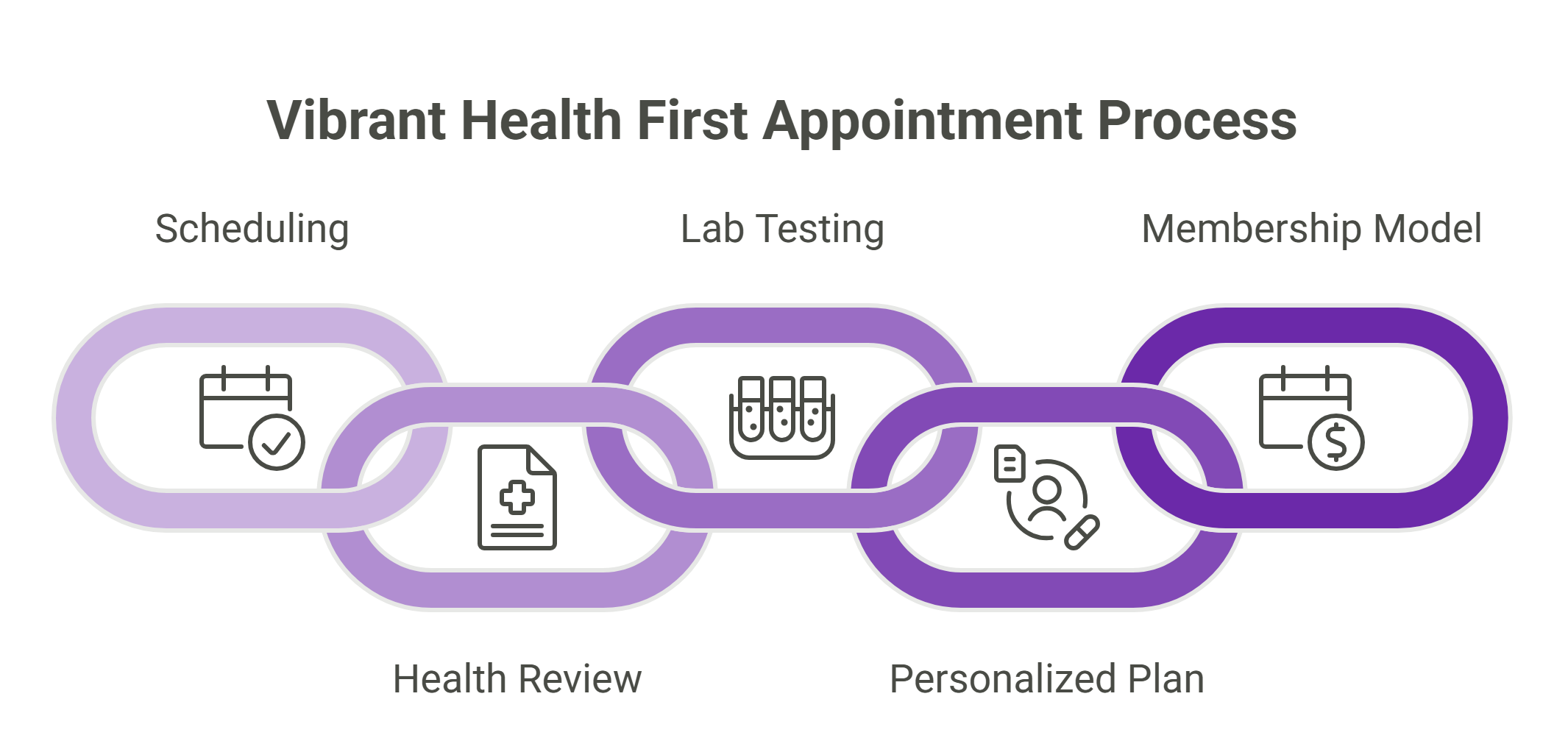
Starting care at Vibrant Health for GLP-1 and hormone evaluation is straightforward, and you begin by scheduling a new patient consultation either in person at our Lone Tree clinic or our Eagle clinic, or via telehealth for any Colorado resident who can’t travel to either location. At your first visit, the provider reviews your full health history, any prior lab results you’ve had, current medications, and the symptom patterns you’ve been experiencing, and nothing is rushed because that’s the point of extended appointments, so we then order a full lab panel covering thyroid, sex hormones, cortisol, and metabolic markers calibrated to what your history suggests we need to look at closely. From there, a personalized plan is built that may include GLP-1 therapy, hormone optimization, thyroid management, lifestyle support, or some combination of all of these, and the Vibrant Health membership model at approximately $225 per month when paid annually provides ongoing access to this coordinated care without per-visit billing surprises, so you know what you’re paying each month and you know what that gets you.
Frequently Asked Questions About GLP-1 and Hormone Imbalance
Why am I not losing weight on semaglutide?
The most common reasons semaglutide stops working are unaddressed hormone imbalances, specifically thyroid dysfunction, declining sex hormones, elevated cortisol, or insulin resistance that wasn’t fully evaluated before starting, because GLP-1 medications are effective at reducing appetite and improving insulin signaling but they work within a hormonal environment, and if that environment is significantly disrupted the medication’s effects are limited by biology rather than willpower.
Can hormone imbalance affect GLP-1 results?
Yes, directly, because thyroid hormones set your resting metabolic rate while estrogen and testosterone affect how your body distributes fat and maintains muscle, and cortisol causes visceral fat storage independent of calorie intake, meaning that when any of these are significantly off balance they counteract the mechanisms GLP-1 medications use to produce weight loss, which is why comprehensive hormone evaluation is often the step that explains a GLP-1 plateau.
Should I get my hormones checked before starting a GLP-1?
We recommend it, because starting a GLP-1 without knowing your thyroid status, sex hormone levels, cortisol picture, and insulin sensitivity means starting treatment without a full clinical picture, and patients who come to us for a GLP-1 weight loss program in Denver receive a complete hormone and metabolic panel before we finalize the plan because those results directly shape how we use the medication.
Does low thyroid make GLP-1 less effective?
It can, significantly, because when thyroid function is suboptimal the body burns fewer calories at rest, which creates a metabolic environment that works against the weight loss GLP-1 therapy is trying to produce, and standard TSH testing misses many cases of functional hypothyroidism, which is why we run a full thyroid panel for every patient entering a weight loss program.
How does perimenopause affect GLP-1 weight loss results?
Declining estrogen and progesterone cause central fat accumulation, reduce lean muscle mass, disrupt sleep, and slow metabolic rate, and GLP-1 medications don’t address any of those mechanisms directly, which means women in perimenopause who are on a GLP-1 but not receiving hormone support are working against a significant biological headwind that the medication alone cannot overcome.
What is the difference between getting a GLP-1 from a med spa versus a functional medicine provider?
A med spa typically prescribes a GLP-1 based on BMI and basic intake information with minimal lab testing and brief follow-up visits, whereas a functional medicine provider evaluates your full hormonal and metabolic picture before prescribing, monitors those markers throughout the program, and adjusts the plan based on how your body is actually responding, and for patients with underlying hormonal imbalances that difference in approach often determines whether the medication works.
Is GLP-1 therapy available through a functional medicine practice in Colorado?
Yes, because at Vibrant Health of Colorado we prescribe GLP-1 medications as part of a broader, hormone-integrated weight loss plan for patients at our Lone Tree and Eagle clinics and via statewide telehealth, and any Colorado resident can access our GLP-1 for weight loss program remotely since the evaluation process is the same whether you come in person or connect with us online.
The Bottom Line: GLP-1 Therapy Works Best When Your Hormones Work With It
GLP-1 medications are a meaningful tool for weight loss and we’re glad they exist, but they work within a hormonal environment, and that environment determines how much the medication can actually accomplish, so thyroid dysfunction, perimenopause, low testosterone, elevated cortisol, and insulin resistance can each place a ceiling on what the medication achieves, and in our experience those ceilings are far more common than most standard programs acknowledge. If you’ve been on a GLP-1 and the results have stalled or never fully arrived, that ceiling is worth finding, and we can help you find it. The patients who see the most sustainable results are the ones who address both the medication and the underlying hormonal environment together, because the two are not separate questions but the same question asked from different angles, so if previous GLP-1 therapy hasn’t delivered what you expected the answer may be a deeper look rather than a different medication. We see patients in our Lone Tree, CO clinic at 10099 RidgeGate Parkway, Suite 410 (303-730-2229), and in our Eagle, CO clinic at 1143 Capitol St., Suite 101A (970-525-2229). Any Colorado resident can connect with us through statewide telehealth without traveling to either location. Wherever you’re at in Colorado, a complete hormone and metabolic evaluation is within reach. Let’s build a plan that actually accounts for what your body is doing!

Deanna Woodroffe, WHNP, is the founder of Vibrant Health of Colorado and a passionate Women’s Health Nurse Practitioner with a focus on functional and integrative medicine. Early in her career, she became frustrated with the inability of traditional medicine to treat her patients’—and her own—chronic symptoms, driving her to pursue a fellowship in Anti-Aging and Functional Medicine. With over twenty years of experience, Deanna helps patients resolve complex, chronic symptoms by focusing on root causes and restoring balance to the body. Her comprehensive approach utilizes bio-identical hormone therapy, thyroid optimization, and addressing lifestyle factors like nutrition and stress to return her patients to feeling vibrant.



Leave a Reply
Want to join the discussion?Feel free to contribute!