
Hormones, Gut Health, and Stress: What’s Really Behind Hair Loss in Women and Men
Functional medicine for hair loss looks at what conventional medicine routinely skips: the hormonal shifts, thyroid dysfunction, gut disruption, and chronic stress patterns that quietly drive hair thinning in both women and men. At Vibrant Health of Colorado, we’ve spent nearly 20 years investigating these root causes under the guidance of Deanna Woodroffe, WHNP-BC, a board-certified Women’s Health Nurse Practitioner with a Fellowship in Anti-Aging and Functional Medicine. This article explains what those causes are, how we test for them, and what treatment looks like once we’ve real answers.

The Short Answer: Why Conventional Medicine Often Misses the Cause
Hair loss in women and men is frequently driven by hormonal imbalances, thyroid dysfunction, gut disruption, nutrient deficiencies, and chronic stress. A standard physical or dermatology visit rarely tests for any of them beyond the basics.
If you’ve been told your labs are normal but you’re still losing hair, you’re not imagining it. Standard thyroid-stimulating hormone (TSH) panels miss impaired T4-to-T3 hormone conversions. Routine bloodwork skips ferritin, sex hormone-binding globulin (SHBG), and adrenal markers entirely. A “normal” result and an accurate result are not always the same thing, and that gap is where the hair loss root cause tends to hide.
Hair Loss Is a Symptom, Not a Diagnosis
Hair follicles move through three phases: anagen (active growth), catagen (transition), and telogen (resting and shedding). Normally, about 85-90% of follicles are in the growth phase at any given time. When the body is under stress, nutrient-depleted, or hormonally disrupted, a larger proportion of follicles shift into telogen simultaneously. The result is what clinicians call telogen effluvium: diffuse shedding across the scalp rather than localized patches.
This is different from androgenetic alopecia, which involves the gradual miniaturization of individual follicles driven by androgens like DHT (dihydrotestosterone). Both can happen at once, and both have identifiable causes that go beyond genetics.
At Vibrant Health, we view hair loss as a body signal worth investigating. It often appears alongside fatigue, mood changes, or digestive issues that patients have been managing separately for years. Treating it as a cosmetic inconvenience, or an inevitable genetic outcome, means missing the systemic imbalances that are actually driving the shedding. Our functional medicine approach treats the body as an interconnected system, and hair loss is one of the clearest signals that something in that system needs attention.
How Hair Loss Hormones Drive Thinning in Women and Men
Hormones regulate the hair growth cycle at every stage. Estrogen extends the anagen phase, which is why hair often looks thicker during high-estrogen periods. When estrogen and progesterone decline, the relative influence of androgens increases, and the growth phase shortens. In women, this often presents as diffuse thinning across the crown rather than a receding hairline.
DHT is the primary androgen driving follicle miniaturization in both sexes. It binds to receptors in the scalp, progressively shrinking the follicle over time. SHBG (sex hormone-binding globulin) is a factor most conventional panels skip, but it determines how much testosterone and DHT are free and active in the bloodstream. A patient can have “normal” total testosterone and still have high free androgen activity if SHBG is low.
We evaluate a full hormone panel: estrogen, progesterone, testosterone, DHT, and SHBG together. Looking at a single marker in isolation does not give us the picture we need. For women with Polycystic ovary syndrome (PCOS) and androgen-driven hair loss, the pattern is especially pronounced, with elevated androgens and insulin resistance compounding each other. Men experiencing andropause face their own version of this: declining testosterone, altered SHBG dynamics, and increased sensitivity to DHT as hormone levels shift with age. These are the hormone imbalance symptoms that directly affect hair, and they are measurable if you run the right tests. Our hormone optimization services address these patterns directly for both women and men.
Why Perimenopause and Menopause Are Turning Points for Hair Health
Hair loss during menopause is one of the most common concerns we hear from women in their late 30s through 50s. The shift begins years before a formal menopause diagnosis, often in perimenopause, when estrogen levels start dropping irregularly.
Falling estrogen reduces the follicle support that the growth phase depends on. At the same time, androgen activity remains relatively stable, which means the androgenic influence on follicles increases even without a rise in absolute androgen levels. Many patients are told this is “just aging,” which is frustrating when a hormone panel would reveal actionable imbalances.
The difference between accepting hair loss as inevitable and doing something about it is often a matter of whether anyone actually ran the right tests.
Hair Loss and the Thyroid: Why TSH Alone Is Not Enough
Thyroid hormones directly regulate the hair follicle growth cycle. Both hypothyroidism and hyperthyroidism can cause diffuse thinning, and Hashimoto’s thyroiditis, the autoimmune form of hypothyroidism, is one of the most common and most overlooked causes of hair loss in women. Our post on Hashimoto’s thyroiditis covers the autoimmune dynamics in detail, but the short version is this: inflammation targeting the thyroid gland can be active and symptomatic long before TSH climbs to a level that triggers a conventional diagnosis.
The hair loss thyroid connection involves the conversion of T4 into the active form T3. When that conversion is impaired, even a patient with a TSH in the “normal” range can have insufficient T3 at the cellular level. Hair follicles are sensitive to this. They don’t wait for TSH to hit 4.5 before they start shedding.
A complete thyroid panel includes: Free T4, Free T3, reverse T3, TPO antibodies, and Tg antibodies. The American Thyroid Association recognizes thyroid dysfunction as a well-established cause of hair loss, and the clinical literature supports using antibody testing to catch Hashimoto’s early. At Vibrant Health, we consistently find that patients who were told their “thyroid is fine” had only had TSH measured. When we run the full panel, the picture often looks quite different.
What ‘Normal’ Thyroid Labs Can Miss
Functional medicine uses optimal reference ranges rather than simply flagging values outside the broad conventional lab range. Subclinical hypothyroidism, where TSH is elevated but still within conventional limits, can cause significant hair shedding before it appears alarming on a standard report. Undiagnosed hypothyroidism explains why so many patients go years without answers.
When a patient tells us their doctor checked their thyroid and it was normal, our next question is always: what specifically did they check? TSH alone does not tell us about conversion, antibody activity, or how much active T3 the body is actually working with. Those details matter, and they are where answers are often found.
Stress and Hair Loss: The Cortisol Connection
Elevated cortisol from chronic stress disrupts the hypothalamic-pituitary-adrenal (HPA) axis and shifts hair follicles into the shedding phase. This is the biological mechanism behind stress and hair loss, and it is well-documented. What surprises many patients is the timing: stress-related shedding typically appears two to three months after the triggering event, which means people often do not connect the dots.
We distinguish between acute stress events (a surgery, an illness, a significant life disruption) and chronic low-grade stress that never fully resolves. Both patterns trigger telogen effluvium, but chronic stress also depletes the nutrients that support hair follicle cycling, including zinc, B vitamins, and iron. The mechanism compounds itself.
We don’t just advise patients to “reduce stress.” We test cortisol levels and evaluate adrenal patterns to understand where in the HPA axis dysfunction is occurring.
Gut Health and Hair Loss: What Happens When Absorption Breaks Down
The gut connection to hair loss is one of the most underappreciated pieces of this puzzle. A disrupted gut microbiome impairs the absorption of iron, zinc, biotin, and vitamin D, and all of these nutrients play direct roles in the hair follicle cycle. You can take the right supplements and eat a careful diet and still be deficient if your gut is not absorbing properly.
Low ferritin (iron stores) is one of the most well-documented and frequently missed causes of hair loss in women. Research indexed on PubMed has confirmed the ferritin-hair loss association, yet it is rarely included in a standard panel. Intestinal permeability, sometimes called leaky gut, allows inflammatory signals into the bloodstream that can affect follicle health systemically, not just locally in the scalp.
Our providers bring specific expertise to these gut-nutrition connections. We evaluate the full picture of how gut dysfunction maps onto nutrient status and hair health, which is a different lens than most primary care or dermatology visits apply. Our gut health services address this directly, and optimizing the gut microbiome is often one of the first steps we take when improving overall health, hair included.
How We Test for Hair Loss at Vibrant Health of Colorado
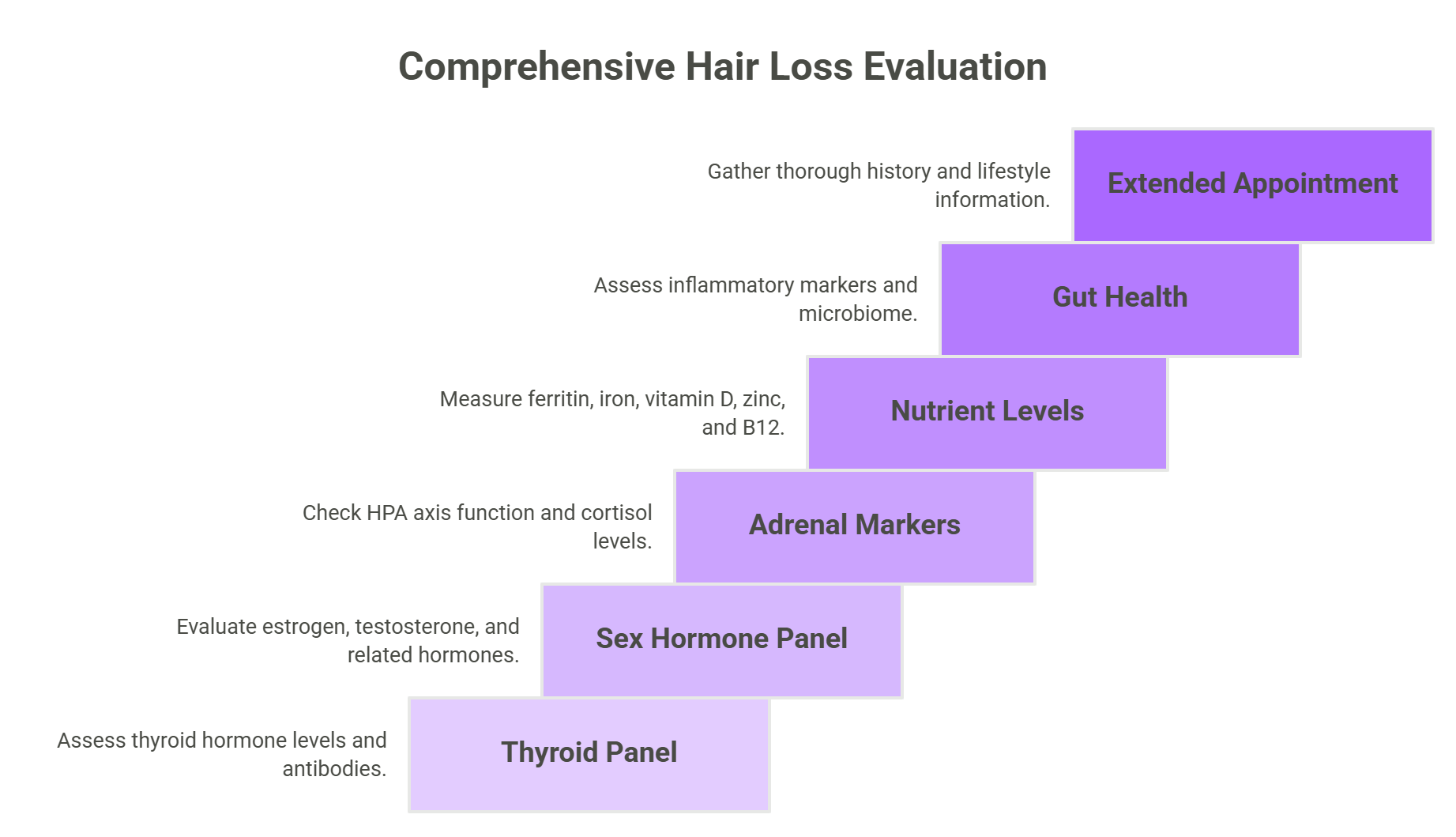
When a patient comes to us with hair loss, we run testing that goes significantly further than what a standard visit orders. Our goal is to identify which combination of factors is driving the shedding, because it is rarely just one. Here’s what a functional medicine hair loss evaluation covers at our practice:
- Complete thyroid panel: Free T4, Free T3, reverse T3, TPO antibodies, Tg antibodies
- Full sex hormone panel: estrogen, progesterone, total and free testosterone, DHT, SHBG
- Adrenal and cortisol markers to assess HPA axis function
- Nutrient levels: ferritin, serum iron, vitamin D, zinc, B12
- Gut health markers as indicated: inflammatory markers, microbiome assessment, nutrient absorption indicators
We also take time. Our extended appointments allow for a thorough history, not a symptom checklist. Understanding the timeline of hair loss, what else changed around the same period, prior diagnoses, medications, and lifestyle patterns all inform how we interpret the lab results. Context matters as much as the numbers.
This is what a test for hair loss actually looks like when you’re trying to find answers rather than rule out disease. If any of this sounds like what you’ve been looking for, schedule a root-cause hair loss consultation with our team. We’ll run the testing that matters and build a plan around what we actually find.
Hair Loss Treatment Women and Men Can Sustain: What Comes After Testing
Once we know what is driving the hair loss, the care plan reflects those specific findings. That might mean bioidentical hormone therapy to restore estrogen and progesterone balance in a perimenopausal patient. For someone with impaired thyroid conversion, it might involve thyroid optimization with attention to Free T3 levels specifically. Gut repair protocols, targeted nutrient repletion, and adrenal support often run in parallel because multiple drivers are usually operating at once.
Hair loss treatment women and men find sustainable is treatment tied to an actual diagnosis. Topical treatments address the surface. Correcting the underlying imbalance addresses the cause. Hair follicles that have been affected by hormonal or nutrient disruption take time to recover, typically measured in months rather than weeks, and care needs to adjust as the body responds.
This is why our functional medicine membership approach makes a real difference here: longer appointments, unlimited portal messaging, and a dedicated care team that stays engaged through the investigation and adjustment process. Root-cause hair loss work is not a one-visit problem, and the membership model is designed for this kind of sustained, personalized care.
Expert Perspective: What Nearly 20 Years of Hormone Optimization Teaches You About Hair
What we see consistently, across hundreds of patients, is that meaningful hair loss rarely has a single cause. The more common pattern is two or three simultaneous drivers, each contributing partially. A patient might have subclinical Hashimoto’s, low ferritin, and perimenopausal estrogen decline all operating at the same time. Address only one and you’ll see partial improvement at best.
We’ve also learned that hair loss carries real emotional weight. It affects how patients see themselves, how they feel walking into a room, and whether they feel like themselves at all. Patients who come to us have often spent years with specialists, been told their labs are normal, and left those visits feeling dismissed rather than helped. We strive to find the root cause of the symptoms so we can resolve them, before resorting to prescriptions, and this philosophy applies to hair loss as directly as it applies to anything else we treat.
When we run a complete evaluation on the first visit, we regularly find the imbalances those earlier appointments missed. That is not a criticism of prior providers. It is a reflection of what a different testing framework, more time, and a whole-systems perspective can reveal. We’ve built our clinical treatments around this kind of investigative care, and that depth of experience shapes how our entire team approaches these cases.
Ready to Find Out What Is Actually Driving Your Hair Loss?
Hair loss in women and men is frequently a signal of something deeper, whether that is hormonal imbalance, thyroid dysfunction, gut disruption, nutrient deficiency, or chronic stress. A functional medicine evaluation is how you find out which one, or which combination, applies to your specific situation.
You don’t have to keep searching for answers alone. We’re here to run the testing that matters and build a plan around what we actually find. Schedule a consultation today, in person at our Lone Tree office serving the Denver Metro area, at our Eagle office serving the Vail Valley, or via telehealth from anywhere in Colorado.
Call Lone Tree: (303) 730-2229 or Eagle: (970) 525-2229, or schedule your consultation online. Let us find what is actually driving your hair loss and build a care plan around what your body is telling us.
Frequently Asked Questions About Functional Medicine for Hair Loss
Can hormones cause hair loss in women?
Yes, and it is one of the most common causes we see. Declining estrogen and progesterone during perimenopause and menopause shift the hormonal balance toward androgens, shortening the hair growth cycle and increasing shedding. Hair loss hormones like DHT also play a role in follicle miniaturization. A full hormone panel, not just a single marker, is what identifies the specific imbalance driving the thinning.
What does the thyroid have to do with hair loss?
Thyroid hormones directly regulate the hair follicle growth cycle. Both hypothyroidism and hyperthyroidism can cause diffuse thinning. The hair loss thyroid connection is particularly relevant in Hashimoto’s thyroiditis, where autoimmune activity disrupts thyroid function even when TSH looks normal. Impaired T4-to-T3 conversion is a common finding in patients with persistent hair shedding and “normal” thyroid labs.
Can stress cause permanent hair loss?
Stress and hair loss are closely linked, but stress-related shedding (telogen effluvium) is usually reversible once the underlying trigger is addressed. Chronic, unresolved stress is more concerning because it continuously depletes nutrients and disrupts hormonal balance. The key is identifying and treating the stress physiology, not just managing symptoms. Hair typically regrows once the root cause is corrected, though recovery takes time.
How does gut health affect hair growth?
Gut health and hair loss are more connected than most patients expect. A disrupted gut microbiome reduces absorption of iron, zinc, biotin, and vitamin D, all of which the hair follicle cycle depends on. Low ferritin from poor iron absorption is a particularly well-documented cause of hair thinning in women. Gut inflammation can also contribute to systemic nutrient deficiencies that show up as shedding before any digestive symptoms become obvious.
What tests should I ask for if I am losing hair?
A thorough test for hair loss should include a complete thyroid panel (Free T4, Free T3, reverse T3, TPO and Tg antibodies), a full sex hormone panel (estrogen, progesterone, testosterone, DHT, SHBG), cortisol and adrenal markers, and nutrient levels including ferritin, vitamin D, zinc, and B12. Most standard panels do not include all of these. Asking specifically for these markers is a good starting point, or working with a provider who runs them routinely.
Does hair loss from hormonal imbalance grow back?
In most cases, yes, once the underlying imbalance is identified and treated. Hair follicles that have been disrupted by hormonal shifts, nutrient deficiencies, or thyroid dysfunction can recover, but it takes time, typically three to six months before noticeable regrowth. The earlier the root cause is identified, the better the outcome tends to be. Sustained improvement requires ongoing monitoring and care adjustments as the body responds to treatment.

Deanna Woodroffe, WHNP, is the founder of Vibrant Health of Colorado and a passionate Women’s Health Nurse Practitioner with a focus on functional and integrative medicine. Early in her career, she became frustrated with the inability of traditional medicine to treat her patients’—and her own—chronic symptoms, driving her to pursue a fellowship in Anti-Aging and Functional Medicine. With over twenty years of experience, Deanna helps patients resolve complex, chronic symptoms by focusing on root causes and restoring balance to the body. Her comprehensive approach utilizes bio-identical hormone therapy, thyroid optimization, and addressing lifestyle factors like nutrition and stress to return her patients to feeling vibrant.



Leave a Reply
Want to join the discussion?Feel free to contribute!